
February 2026 Update: 100+ AI Analytics tools in the db
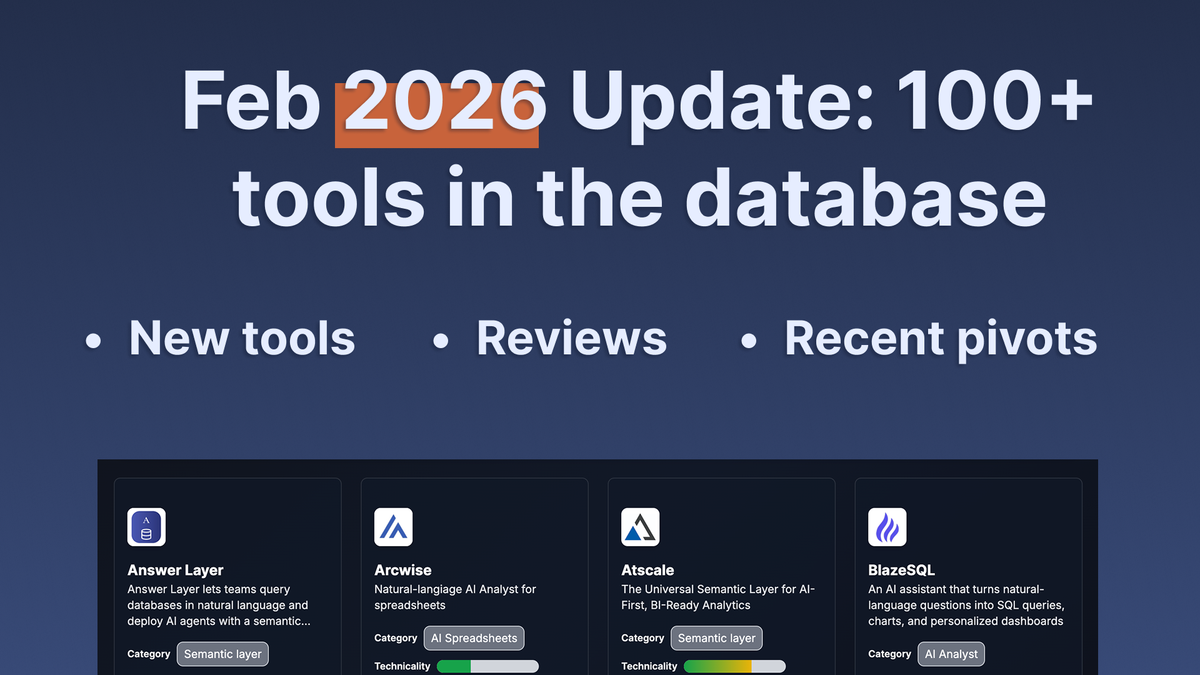
A February update to the AI Analytics directory. 33 AI tools for data analysis have been added across all categories. Tool reviews and pivot insights.

Mike Kosorukov
Co-founder of AI Analytics Hub
Update overview
Making up for the missed update (The directory is set to be updated Bi-weekly) I've reviewed and added a total of 33 tools, some of which are new, and some I just couldn't find before.
I'm not saying this is the exhaustive map of the AI Analytics landscape, but we're getting closer:)
33 new tools added
I was genuinely surprised by how consistently I keep finding new AI tools for data analytics. I thought I had covered 90+% of the market, but in the last month, I found and added 32 new tools:
- 24 new tools for the AI Analyst category
- 3 new tools for the Qualitative AI Analytics category
- 3 new tools for the AI Spreadsheets category
- 2 new tools for the Text-to-SQL category
- 2 new tools for the Data pipeline assistant category
- 1 new tool for the Semantic Layer category
Notable new entries
There were a few tools that caught my attention.
Nebuly (https://www.nebuly.com/) is a qualitative analytics tool that provides insights into how users interact with your AI agents. There are a few tools out there for quantitative AI agent analytics, but it's the first one I found that gives you not just numbers but the topic patterns, intent, sentiment, and emotions behind user<>AI interactions.
What's more interesting is the ability to explicitly collect user feedback on AI agent performance beyond thumbs up/down, providing a peek into the "Why" behind LLM issues (although I haven't tested this feature and am taking it at face value).
Trufflepig (https://trufflepig.ai/) is a lightweight AI-first spreadsheet tool that acts as a co-pilot inside your Excel, allowing you to do the usual AI spreadsheets stuff: clearing/organizing data, getting insights via natural-language chat, and creating charts and reports.
Its overlay AI chat window eats additional context from PDFs and can search and reference information on the Web.
Sherloq (https://www.sherloqdata.io/), although I placed it in the Text-to-SQL category, is in fact more of an SQL co-pilot or SQL IDE if you will. The SQL-first interface should be more efficient than other Text-to-SQL tools, where the AI chat is the primary UI layer and SQL is its output.
Kater (https://www.kater.ai/) is a quiet entry, with very little online presence, but surprisingly, it offers capabilities that only a handful of other AI analyst tools do: AI-based notebooks, semantic modeling, and governance/autoring.
The data can be presented as structured decision trees, which I saw only in three other tools.
Plexe (https://www.plexe.ai/) and a few similar tools allow users to build ML models using natural language to assist data engineers. It belongs to a relatively new cohort of tools that aim to assist/replace data engineers.
These tools deserve their own category, which will be added in the next update.
Pivots
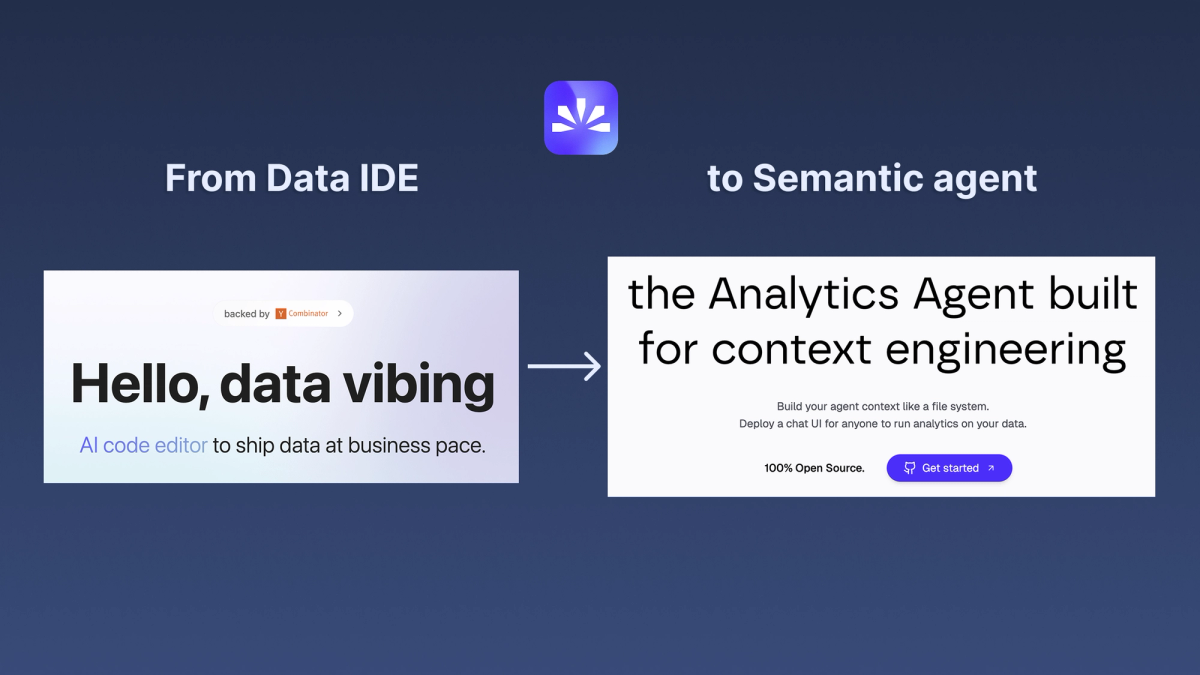
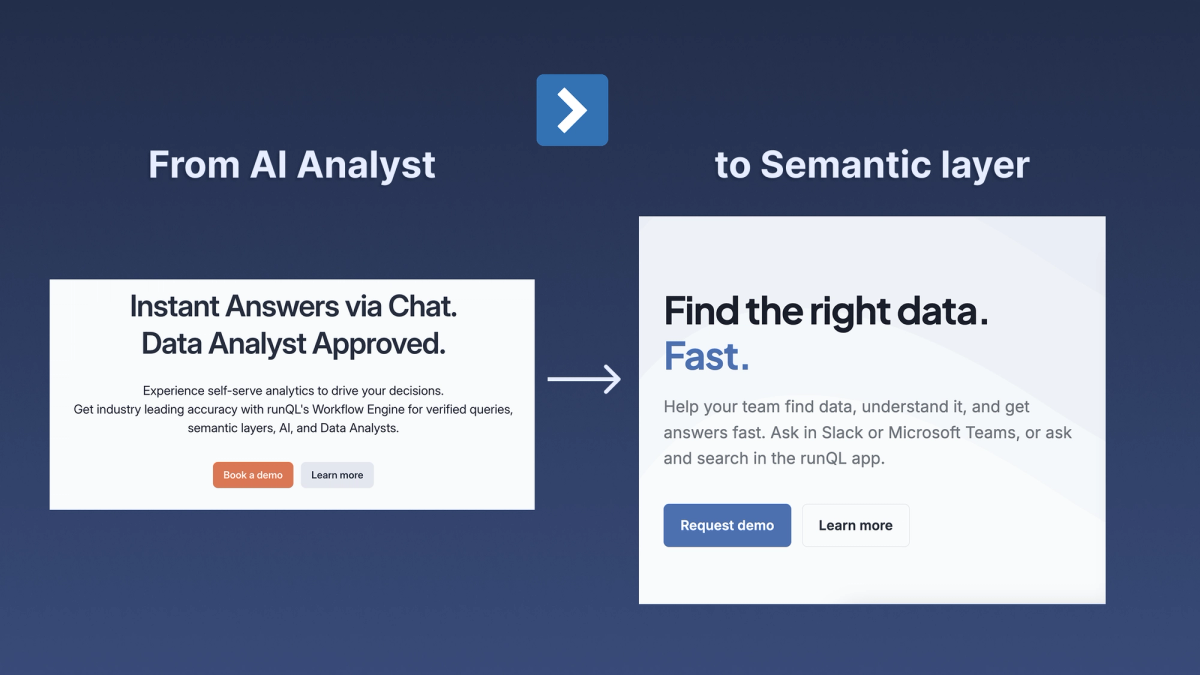
Several tools have pivoted in recent months, which is interesting not only from a per-tool POV but also as a market trend signal. Below are two of the most interesting ones, both now serving the AI agent<>Data gap.
Nao (https://getnao.io/) was a data IDE on its way to becoming a "Cursor" for data teams and now focuses on democratizing semantic modeling. They also went open-source.
---
RunQL (https://runql.com/) was initially a text-to-SQL tool, then pivoted into an AI Analyst. Now, although they do have the "AI Analyst" component (almost all Semantic Layer AI tools have it), the focus is clearly on the context layer.
Other tools
Check out the newest additions in the only curated directory of AI tools for data analytics: https://aidataanalytics.io/
If you think there's a tool that belongs, submit it via the Submit button in the top right.

Written by
Mike Kosorukov
Co-founder of AI Analytics Hub